
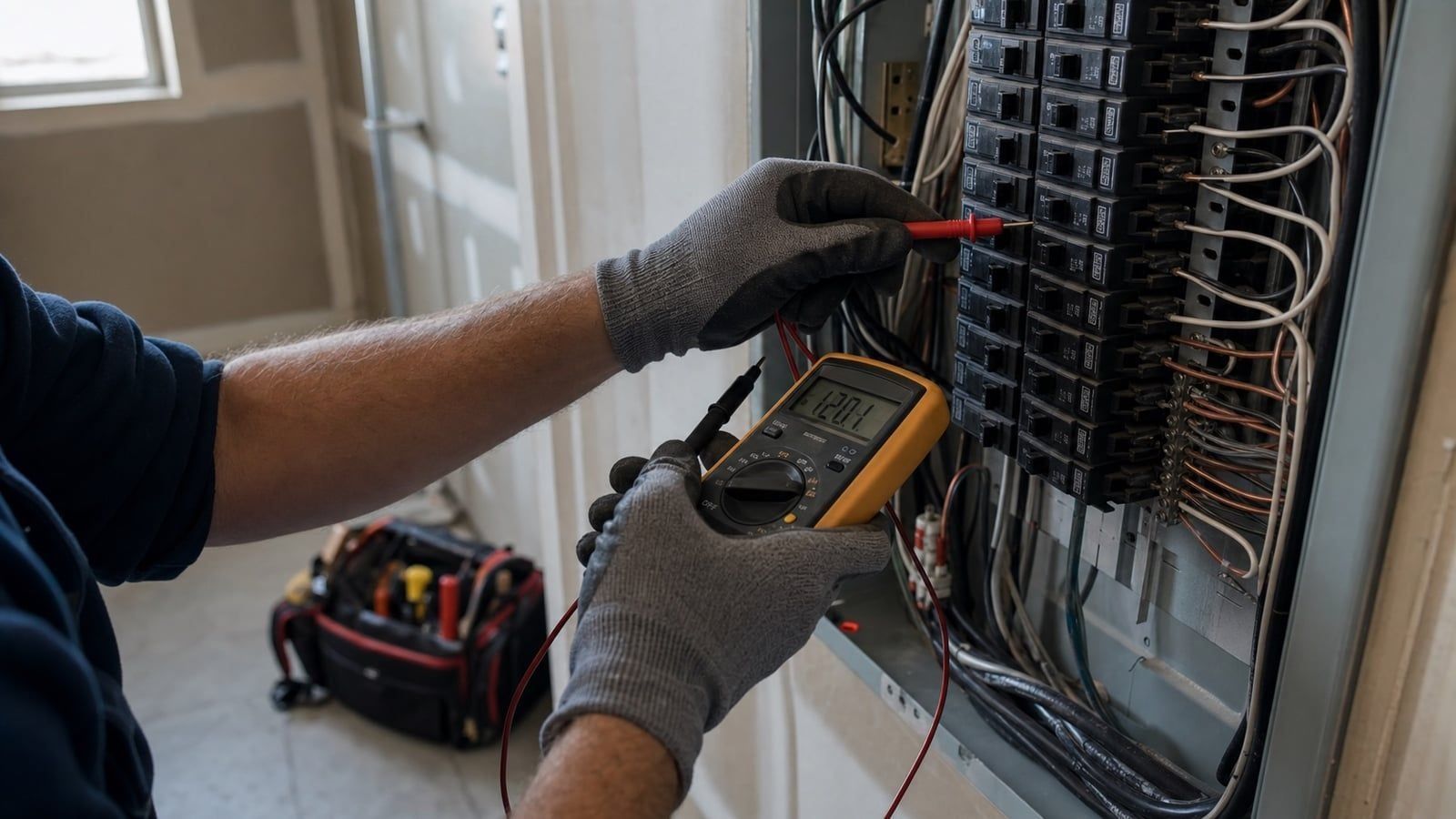
After the Holidays: Why You Should Schedule an Electrical Safety Inspection
The decorations are down, the guests have gone home, and your electrical system just survived its biggest annual stress test. January is the perfect time for an electrical safety inspection—here's why the issues that surface during the holidays shouldn't be ignored.
Holiday Electrical Stress: The Annual System Test
Think of the holidays as your home's electrical stress test. For 4-6 weeks, your system handled:
Loads it never sees otherwise:
- Outdoor lighting displays running 6-8 hours daily
- Kitchen circuits at maximum capacity for holiday cooking
- Multiple space heaters for guests in cold rooms
- Entertainment systems running continuously
- Inflatable decorations and animated displays
- Extension cords running everywhere
What this reveals:
- Circuits operating at their limits
- Connections loosened by heat cycling
- Breakers approaching failure from repeated trips
- Wire insulation degraded by sustained heat
- Outlets weakened from constant high loads
If you experienced any of these during the holidays, your system is telling you something:
- Breakers that tripped (even once)
- Flickering lights when cooking
- Outlets that felt warm
- Extension cords that felt hot
- GFCIs that tripped repeatedly
- Lights dimming when heaters kicked on
- Burning smells (even brief ones)
These aren't random occurrences—they're warnings.
What Electricians Find in Post-Holiday Inspections
We do dozens of post-holiday inspections every January. Here's what we consistently find:
Problem 1: Outlets degraded by holiday loads
What happens: Outlets have spring-loaded contacts that grip plugs. Repeated plugging/unplugging and sustained high loads weaken these springs. After a heavy holiday season, outlets may:
- Not grip plugs firmly
- Arc and spark when plugging things in
- Feel loose or wiggly
- Show discoloration or burn marks
Why it matters: Loose connections create resistance. Resistance creates heat. Heat degrades insulation and eventually starts fires. We find 3-5 outlets per home needing replacement in post-holiday inspections.
Cost to fix: $40-60 per outlet replaced Cost to ignore: Electrical fire causing tens of thousands in damage
Problem 2: Breakers weakened by holiday cycling
How breakers wear out: Every time a breaker trips, it experiences mechanical and thermal stress. A breaker might trip 1-2 times per year normally. During the holidays, some homeowners reset breakers 5-10+ times.
After heavy tripping, breakers may:
- Trip at lower loads than their rating
- Not trip when they should (dangerous)
- Feel hot during normal loads
- Take longer to reset
We test every breaker during post-holiday inspections:
- Apply test loads to verify trip points
- Measure temperature under load
- Check mechanical function
- Test arc-fault and GFCI breakers
Breakers needing replacement: 1-2 per inspection on average
Cost to fix: $75-125 per breaker replaced Cost to ignore: Overheated wiring, potential fire
Problem 3: Wire connections loosened by thermal cycling
The thermal cycle problem: Electrical loads create heat. Heat causes wire and connectors to expand. When loads shut off, they cool and contract. Repeat this hundreds of times (hello, holiday lights on timers), and connections loosen.
Loose connections cause:
- Arcing (electricity jumping gaps)
- Extreme heat at connection points
- Further degradation in a feedback loop
- Eventually: fire
We find loose connections in:
- Outlet and switch connections
- Junction boxes in attics (from holiday light loads)
- Panel breaker connections
- Aluminum wiring connections (especially problematic)
You can't see these problems—they're inside walls and boxes.
Cost to fix: $100-400 depending on accessibility Cost to ignore: House fire
Problem 4: Extension cord damage
Holiday extension cord abuse:
- Cords run under rugs, through doorways, buried in snow
- Overloaded with multiple devices
- Damaged by foot traffic, furniture, shovels
- Exposed to temperature extremes
Post-holiday inspection includes checking all extension cords you used:
- Look for cuts, frays, or exposed wires
- Feel for hard or brittle insulation (cold damage)
- Check plugs for looseness or burn marks
- Test GFCI function on outdoor cords
Damaged cords must be discarded—not repaired.
Cost to replace: $15-40 per cord Cost to ignore: Shock or fire hazard next year
Problem 5: Outdoor outlet weatherproofing compromised
Winter weather + holiday use = damage:
- Cover gaskets dried out from cold
- Covers left open for extended periods
- Water intrusion from snow/ice
- GFCI internal damage from moisture
We find outdoor outlet issues in 40% of post-holiday inspections.
Signs of damage:
- Visible corrosion on outlets or plugs
- GFCIs that don't test properly
- Water visible inside outlet boxes
- Covers that don't seal properly
Cost to fix: $75-150 per outlet Cost to ignore: Shock hazard, code violation, system damage
Problem 6: Aluminum wiring connections requiring service
If your home was built 1965-1975, you likely have aluminum wiring: Aluminum expands/contracts more than copper with temperature changes. Holiday loads accelerate connection degradation.
Aluminum wiring needs special attention:
- Connections require special compounds
- Regular inspection and maintenance needed
- Some connections need complete replacement
We find aluminum wiring issues in 60% of homes that have it.
Cost to address: $800-2,000 for whole-home connection service Cost to ignore: Aluminum wiring is a leading cause of house fires
The Tax Deduction Opportunity
Here's something many homeowners don't know: electrical repairs and safety upgrades may be tax-deductible.
How it works:
IRS Publication 502 - Medical and Dental Expenses: If electrical work is medically necessary (supporting medical equipment, improving safety for disabled family members), it may be deductible as a medical expense.
Home Office Deductions: If you have a legitimate home office, electrical upgrades to that space may be deductible as business expenses.
Energy Efficiency Tax Credits: Some electrical upgrades qualify for federal tax credits:
- Heat pump water heaters: Up to $2,000 credit (2024-2032)
- Electrical panel upgrades for efficiency: Up to $600 credit
- EV charger installation: Up to $1,000 credit (income limits apply)
- Home energy audits: Up to $150 credit
How to maximize this:
1. Get inspection in January: Have documented assessment of electrical issues from 2024 holiday season.
2. Complete repairs before tax deadline: Repairs done January-April 2025 can potentially be claimed on 2024 taxes (if filing extension) or documented for 2025.
3. Keep detailed records:
- Inspection reports
- Itemized invoices
- Before/after photos
- Receipts
4. Consult your tax professional: We're electricians, not accountants. Your tax advisor can tell you exactly what's deductible for your situation.
Example scenario:
- Post-holiday inspection: $175
- Outlet replacements (6): $300
- Breaker replacements (2): $200
- Panel connection service: $400
- Total: $1,075
If even a portion qualifies as medical or business expense, tax savings can offset 20-30% of costs.
Planning Spring Projects Now
January-March is the best time to plan electrical projects for the year. Here's why:
1. Our schedule is less busy: We're not competing with:
- Holiday lighting installation (Nov-Dec)
- Air conditioning failures (June-Aug)
- Heating emergencies (Dec-Feb peaks)
This means:
- More flexible scheduling
- More time for consultation and planning
- Potentially better pricing
- No rush to complete work
2. You remember what didn't work: Right now you clearly remember:
- Which circuits overloaded during holiday cooking
- Where you needed outlets but ran extension cords
- What breakers tripped repeatedly
- Which rooms were uncomfortably cold (heating circuit issues)
By June, you'll have forgotten these details.
3. Work is done before next season: Projects planned in January can be completed by spring, meaning:
- Next holiday season will be smooth
- Summer cooling season won't stress weak circuits
- Home improvements done before warm weather entertaining
4. Tax refunds fund projects: Many homeowners use tax refunds for home improvements. Plan the projects now, execute them when the refund arrives.
Common post-holiday project requests:
Kitchen circuit additions ($600-1,200): If holiday cooking caused repeated breaker trips, add dedicated circuits. This isn't just for holidays—makes cooking easier year-round.
Outdoor outlet additions ($250-400 each): Stop running extension cords for holiday lights. Strategic outdoor outlets make decorating easier and safer.
Panel upgrades ($3,000-5,000): If your whole system felt strained, you might need a service upgrade from 100A to 200A. This enables:
- Modern electrical loads
- Future EV charger installation
- Solar panel preparation
- Whole-home generator
- Added home value
Generator installation ($2,000-15,000): If you lost power during the holidays (or worried about it), now's the time to install backup power before next winter.
GFCI/AFCI upgrades ($1,200-1,800): Bring your home up to modern safety standards. Required for many home sales anyway.
Dedicated circuits for problem areas ($400-700 each): That bedroom where the space heater always trips the breaker? Needs its own circuit.
Smart home integration ($800-2,000): Smart switches, outlets, thermostats, and whole-home energy monitoring make your home more efficient year-round.
The January Inspection Special
We offer comprehensive post-holiday electrical inspections January-March:
What's included ($175-225):
- Complete panel inspection and testing
- Every outlet tested (voltage, grounding, GFCI function)
- All switches tested
- Thermal imaging of panel and high-load areas
- Outdoor outlet assessment
- Circuit load analysis
- Aluminum wiring check (if applicable)
- Detailed written report
- Prioritized repair recommendations
- Project planning consultation
What we provide:
- Immediate safety issues: Anything requiring urgent attention
- Near-term concerns: Issues to address within 3-6 months
- Long-term planning: Upgrades to consider over next 1-2 years
- Cost estimates: For all recommendations
- Prioritization guidance: What to do first and why
Average inspection findings:
- 2-4 safety concerns requiring attention
- 1-2 code violations (often minor, easily fixed)
- 3-5 improvement opportunities
- 1-2 efficiency upgrades worth considering
Most homeowners spend $400-1,200 addressing immediate findings from the inspection.
DIY Post-Holiday Electrical Checks
Before scheduling a professional inspection, you can do some preliminary checks:
Visual outlet inspection:
Walk through your home and inspect every outlet:
- Look for discoloration (brown or black marks)
- Feel for warmth (should be room temperature)
- Check for loose cover plates
- Note any outlets that were used heavily during holidays
Discard any damaged extension cords:
- Cut the plug off (prevents someone finding and using it)
- Look for any damage: cuts, frays, exposed wire, brittle insulation
- Check plugs for burn marks or damage
Test all GFCI outlets:
- Press TEST button—power should cut immediately
- Press RESET—power should restore
- If TEST doesn't work, the GFCI is failed and needs replacement
Test smoke detectors:
- Press test button on each detector
- Replace any non-functional units
- Replace batteries in battery-powered units
- Detectors older than 10 years should be replaced
Inspect electrical panel:
- Open panel door (carefully)
- Look for any signs of burning, discoloration, or rust
- Smell for burning odors
- Look for breakers that aren't fully seated
- Note any breakers in the tripped position
- Check for any warm breakers (shouldn't be warm when not loaded)
Document issues: Take photos of anything concerning:
- Discolored outlets
- Damaged cords
- Panel issues
- Areas where you'd like additional outlets
This documentation helps during professional inspection.
Preparing for Next Year
Post-holiday inspection isn't just about fixing problems—it's about planning for next year:
Create a holiday electrical plan:
1. Document what worked:
- Which circuits handled holiday loads fine
- Where you had adequate outlets
- What extension cords performed well
2. Document what didn't:
- Which circuits overloaded
- Where you needed outlets but didn't have them
- What breakers tripped
- What cords need replacement
3. Plan improvements:
- Additional circuits needed
- Outlets to add
- Lighting upgrades
- Capacity increases
4. Budget for upgrades: Spread costs over the year:
- January-March: Planning and non-urgent repairs
- April-June: Major projects (panel upgrades, circuits)
- July-September: Outdoor work (outlet addition)
- October-November: Final prep and testing before holidays
5. Schedule key work:
- Spring: Major electrical projects
- Fall: Pre-holiday inspection and minor fixes
- Year-round: Maintenance and monitoring
Common Questions About Post-Holiday Inspections
Q: I didn't have any major problems during the holidays. Do I still need an inspection?
If you didn't have breaker trips, flickering lights, or other obvious issues, you're probably fine. But consider an inspection if:
- Your home is over 20 years old
- You've never had an electrical inspection
- You're planning to sell within 2 years
- You ran heavy holiday loads (lots of decorations, cooking)
- You have aluminum wiring (common 1965-1975)
Q: How often should I have electrical inspections?
Recommended frequency:
- Every 3-5 years for homes under 25 years old
- Every 2-3 years for homes 25-40 years old
- Annually for homes over 40 years old
- After any major event (lightning strike, power surge, heavy load period)
- Before buying or selling a home
Q: What's the difference between inspection and repair costs?
Inspection is diagnostic:
- $175-225 for comprehensive assessment
- No repairs included
- Written report and recommendations
Repairs are separate:
- Priced based on findings
- You choose what to address and when
- Can prioritize based on safety and budget
Q: Will inspection require repairs immediately?
Not usually. We categorize findings:
- Immediate safety issues: These should be addressed now (loose wires, failed GFCIs, etc.)
- Near-term: Address within 3-6 months
- Long-term: Plan over next 1-2 years
You control timing based on budget and priorities.
Q: Can I do repairs myself?
Some basic work is DIY-appropriate:
- Replacing outlet covers
- Replacing light fixtures
- Replacing standard outlets and switches (if you're comfortable)
Professional work required for:
- Anything inside the panel
- Adding circuits
- Aluminum wiring work
- Outdoor installations
- Anything requiring permits
Utah requires permits and licensed electricians for most electrical work. DIY work that isn't up to code becomes a problem when you sell your home.
Q: How long does inspection take?
Typical home (1,500-2,500 sq ft): 2-3 hours Larger home (3,000+ sq ft): 3-4 hours Includes:
- Physical inspection
- Testing
- Thermal imaging
- Report preparation
- Consultation
We can usually complete inspection while you're at work, then discuss findings by phone or email.
Special Focus: Aluminum Wiring
If your Northern Utah home was built 1965-1975, it likely has aluminum wiring. The holidays stress aluminum connections more than copper.
Why aluminum is concerning:
1. Expansion/contraction: Aluminum expands and contracts significantly with temperature changes (more than copper). This loosens connections over time.
2. Oxidation: Aluminum oxidizes when exposed to air, creating a resistive coating on connections. This causes heat, which accelerates oxidation in a dangerous feedback loop.
3. Galvanic corrosion: When aluminum contacts copper (or brass in outlets/switches), galvanic corrosion occurs, degrading the connection.
Post-holiday aluminum wiring inspection includes:
1. Outlet and switch connections: We remove and inspect every outlet and switch:
- Check for proper anti-oxidant compound
- Look for discolored or overheated connections
- Verify proper connection methods (crimp, not wire-nut in most cases)
- Replace any outlets/switches not rated for aluminum
2. Panel connections: Aluminum connections at breakers and main lugs are critical:
- Check torque (connections can loosen)
- Look for oxidation
- Measure temperature under load
3. Junction boxes: Anywhere wires connect needs inspection:
- Verify proper splicing methods
- Check for oxidation
- Ensure adequate anti-oxidant compound
Aluminum wiring isn't necessarily dangerous—poorly maintained aluminum wiring is dangerous.
Cost for aluminum wiring maintenance:
- Whole-home outlet/switch connection service: $1,200-2,000
- Panel connection service: $400-700
- Junction box updates: $150-400 depending on quantity
This should be done every 3-5 years in aluminum-wired homes.
Emergency Signs Requiring Immediate Service
Some post-holiday findings require immediate attention, not scheduled inspection:
Call us immediately if you notice:
After holidays:
- Burning smell that persists
- Outlets that are hot (not just warm)
- Breakers that trip immediately when reset
- Visible burn marks or melting on outlets
- Buzzing or crackling sounds from panel or outlets
- Lights flickering throughout the house
- GFCIs that won't reset
Don't wait for scheduled inspection—these are emergency situations.
After power outages:
- Panel that smells burned
- Breakers that won't reset
- Entire circuits not working
- Partial power in home (some circuits work, others don't)
Long-Term Electrical System Health
Post-holiday inspection is part of overall electrical system maintenance:
Complete electrical maintenance plan:
Annual:
- Test all GFCI outlets (DIY)
- Test all smoke detectors (DIY)
- Check for loose outlet covers (DIY)
- Inspect visible wiring for damage (DIY)
Every 3-5 years:
- Professional electrical inspection
- Panel cleaning and connection torque check
- Load analysis and capacity assessment
- Code compliance review
Every 10 years:
- Smoke detector replacement
- Consider major upgrades (panel, circuits)
- Evaluate home for modern electrical needs
As needed:
- After any electrical issues
- Before and after major renovations
- When buying or selling
- After severe weather events
This approach ensures:
- Safety for your family
- Optimal system performance
- Long equipment life
- Maintained home value
- No unexpected failures
We're Here to Help
Post-holiday electrical inspection sets you up for a safe, efficient year ahead. Whether you experienced issues during the holidays or simply want peace of mind, we're here to help.
Our post-holiday services:
- Comprehensive electrical inspections
- Priority scheduling for safety issues
- Detailed reporting and documentation
- Project planning consultation
- Competitive pricing on identified repairs
- Financing available for major projects
January-March specials: During our slower season, we offer:
- Extended inspection appointments (more thorough assessment)
- Free project consultations with inspection
- Bundled pricing for inspection + repairs
- Flexible scheduling
Serving all of Northern Utah: Salt Lake City, Ogden, Layton, Kaysville, Farmington, Centerville, Bountiful, and throughout Davis and Weber Counties.
Call 801-458-0831 or request a free quote to schedule your post-holiday electrical inspection.
Brightline Electric is a licensed and insured electrical contractor serving Northern Utah. We provide comprehensive electrical inspections, safety upgrades, and maintenance services to keep your home safe year-round.