
New Year, Lower Electric Bills: 10 Electrical Upgrades That Pay for Themselves
New Year's resolutions usually include saving money, and your home's electrical system offers some of the best returns on investment available. Unlike gym memberships that sit unused by February, electrical upgrades deliver savings every single month. Here are 10 upgrades that pay for themselves, with real math for Northern Utah homes.
1. Complete LED Conversion: The Obvious Winner
If you haven't converted to LED lighting throughout your home, this is the single best energy investment you can make.
The old lighting reality: Many Utah homes still have a mix of incandescent, CFL, and LED bulbs. Those older bulbs are costing you money every day they're on.
Energy usage comparison (per bulb, per year):
- 60W incandescent: 219 kWh/year at 10 hours/day = $24/year
- 13W CFL: 47 kWh/year = $5.17/year
- 9W LED: 33 kWh/year = $3.63/year
Typical Utah home (40 bulbs):
- All incandescent: $960/year
- Mixed (20 incandescent, 15 CFL, 5 LED): $520/year
- All LED: $145/year
Converting from mixed to all LED:
- Investment: 35 bulbs × $4 = $140
- Annual savings: $375
- Payback: 4-5 months
- 10-year savings: $3,750
Beyond the electricity savings:
- LEDs last 15,000-50,000 hours (10-25 years)
- Incandescent bulbs last 1,000 hours (less than 1 year)
- You'll spend $200-400 over 10 years on replacement incandescent bulbs
- LED replacement cost over same period: $0-50
Better lighting quality: Modern LEDs offer:
- Dimmable options (make sure bulb and dimmer are compatible)
- Color temperature choices (warm white to daylight)
- Instant-on (unlike CFLs)
- No mercury (unlike CFLs)
Don't forget these locations:
- Recessed can lights (huge energy waste with incandescent)
- Garage and workshop
- Outdoor security and porch lights
- Closets and storage areas
- Basement and utility rooms
Professional upgrade opportunity: If you have old recessed fixtures that don't fit LED bulbs well, we can upgrade to modern LED fixtures. Cost is $50-100 per fixture installed, but provides better light distribution and efficiency.
2. Smart Thermostat Installation: Year-Round Savings
Smart thermostats are one of the few upgrades that deliver immediate, measurable savings with minimal investment.
Average savings: Studies show 10-15% reduction in heating and cooling costs. For a typical Utah home spending $150/month on electricity (heavily heating-focused in winter):
- Annual heating/cooling cost: ~$1,200
- Smart thermostat savings: $120-180/year
Cost and payback:
- Nest, Ecobee, or Honeywell smart thermostat: $200-250
- Professional installation: $150-200
- Total investment: $350-450
- Payback: 2.5-3 years
- 10-year savings: $1,200-1,800
How they save money:
1. Occupancy learning: Learns your schedule and reduces heating/cooling when you're away. Typical savings: 8-10% of HVAC costs.
2. Smart recovery: Starts heating/cooling at precisely the right time to reach desired temp when you wake or arrive home—no more running overnight.
3. Weather integration: Adjusts based on outdoor temperature and forecasts. On sunny winter days, delays heating because passive solar will warm your home.
4. Usage reports: Shows exactly when and how you're using energy, helping you identify waste.
5. Remote access: Forgot to adjust before vacation? Do it from your phone. Extended your trip? Adjust remotely.
Rocky Mountain Power incentive: Utah's major utility offers rebates for smart thermostat installation—often $50-100. Check current programs at RockyMountainPower.net.
Best models for Utah:
- Ecobee SmartThermostat: Built-in remote sensors (great for multi-level homes)
- Nest Learning Thermostat: Best learning algorithms
- Honeywell T9: Good balance of features and price
Multi-zone opportunities: Homes with multiple HVAC zones see even bigger savings. Install smart thermostats on each zone for precise control.
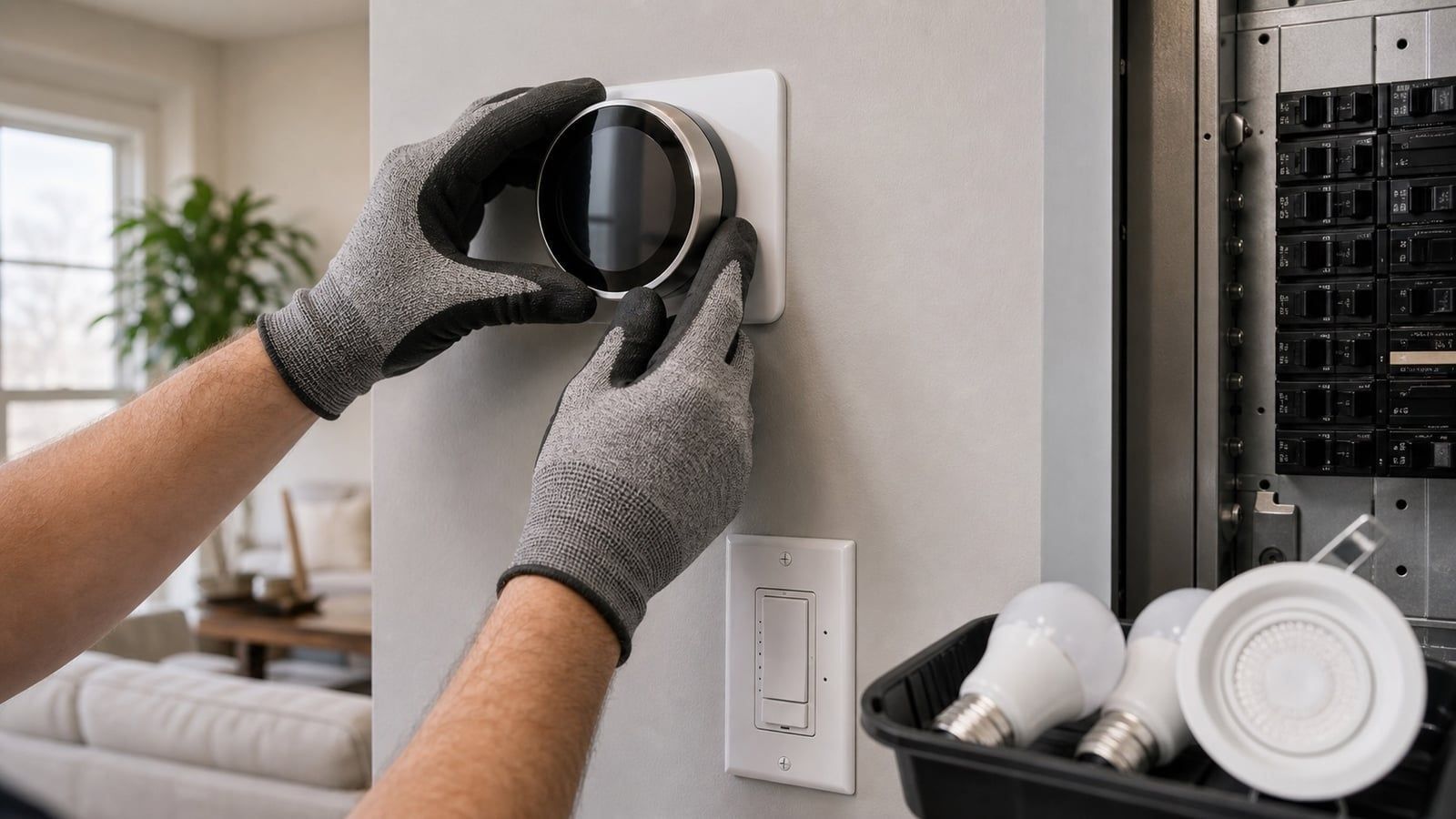
We install and configure: Smart thermostat installation takes 1-2 hours including:
- Old thermostat removal
- Wire compatibility check (may need common wire added)
- New thermostat installation
- WiFi connection and app setup
- Programming and demonstration
Cost: $150-200 installed (in addition to thermostat cost).
3. Phantom Load Elimination: Easy Monthly Savings
"Phantom loads" are devices drawing power 24/7 even when "off." This hidden energy waste costs the average home $100-200 per year.
Biggest phantom load culprits:
- Cable/satellite boxes: 15-30W constant = $15-33/year each
- Game consoles: 10-15W in "rest mode" = $10-16/year
- Desktop computers: 5-20W when "off" = $5-22/year
- Older TVs: 5-10W standby = $5-11/year
- Microwave clock: 3-5W = $3-5/year
- Garage door openers: 4-7W = $4-8/year
- Printers: 5-10W = $5-11/year
Typical home phantom load: 50-100W constant
- 75W × 24 hours × 365 days = 657 kWh
- At Utah's $0.11/kWh = $72/year wasted
Solutions:
Smart power strips ($20-40 each):
- Master outlet controls peripheral outlets
- Turn off TV, and the power strip cuts power to cable box, sound system, etc.
- Eliminates phantom loads automatically
- Investment: 5 strips × $30 = $150
- Annual savings: $60-100
- Payback: 18 months
Smart plugs ($15-25 each):
- Control individual devices from phone
- Set schedules (desktop computer off at midnight)
- Monitor energy usage per device
- Investment: 10 plugs × $20 = $200
- Annual savings: $50-80
- Payback: 2.5-3 years
- Bonus: Adds smart home control to dumb devices
Whole-home energy monitoring: Devices like Sense or Emporia monitor your entire electrical panel:
- Cost: $300-400 installed
- Identifies every device's energy usage
- Alerts to unusual consumption
- Tracks solar production (if you have panels)
Our approach: We'll install a whole-home energy monitor during any service call. Takes 30 minutes, costs $250-300 installed. You'll immediately see what's using power and where you can save.
4. Panel Upgrade: The Foundation for Everything Else
Many Utah homes built before 1990 have 100-amp electrical service. This was adequate then, but severely limits you now.
Signs you need a panel upgrade:
- Frequent breaker trips
- Lights dim when major appliances start
- You can't run multiple appliances simultaneously
- You want to add solar but don't have capacity
- You want to install EV charger
- Your panel has Federal Pacific or Zinsco breakers (fire hazards)
- Home inspector flagged your panel
- You're planning major renovations
100-amp vs 200-amp service:
100-amp service capacity: 24,000 watts Typical modern home usage:
- Central A/C: 3,500W
- Electric dryer: 5,000W
- Electric range: 12,000W
- Water heater: 4,500W
- Furnace blower: 600W
- Just these 5 items: 25,600W
You can't run everything simultaneously. You're managing loads constantly, and you definitely can't add solar or an EV charger.
200-amp service capacity: 48,000 watts You can run everything plus charge an EV, add solar, install a hot tub, and still have headroom for future expansion.
Upgrade cost and payback:
- 200-amp panel upgrade: $2,500-4,000
- Utility meter upgrade: $300-800
- Permit and inspection: $200-400
- Total: $3,000-5,000
Direct savings: None immediately, but:
- Enables solar (20-30% electricity reduction)
- Enables EV charging (saves $1,500-2,500/year vs gas)
- Prevents damage to electronics from voltage drops
- Required for home sale in many cases
- Increases home value $5,000-8,000
The solar math: If you're considering solar, you need adequate electrical service:
- Panel upgrade: $3,500
- 8kW solar system: $16,000 ($11,200 after federal tax credit)
- Annual electricity savings: $1,200-1,600
- Combined payback: 8-10 years
- 30-year savings: $36,000-48,000
The panel upgrade is required foundation that unlocks massive long-term savings.
5. Attic Ventilation and Insulation Support
Proper attic ventilation isn't purely electrical, but adding attic fans and ensuring proper ventilation dramatically reduces cooling costs.
The Utah attic problem: Summer attics reach 140-160°F in direct sun. This heat radiates through your insulation, forcing A/C to work overtime.
Attic fan solution:
- Solar-powered attic fans: $400-600 installed
- Hardwired attic fans with thermostat: $500-800 installed
- Temperature-controlled (turns on at 100°F, off at 85°F)
Savings: Studies show 10-15% reduction in summer cooling costs:
- Summer cooling (June-Sept): $400 typical
- Savings: $40-60/year
- Payback: 8-12 years
This isn't the fastest payback, but delivers:
- Longer A/C life (less strain)
- More comfortable upper floors
- Prevents heat damage to attic stored items
- Reduces ice dam risk in winter (proper ventilation prevents heat buildup)
We recommend: Solar-powered units—no wiring needed, pure savings, no operating cost.
6. GFCI and AFCI Protection: Safety + Efficiency
Modern electrical code requires GFCI (ground fault) and AFCI (arc fault) protection. Older homes often lack these, creating safety risks and potential energy waste.
What these do:
GFCI outlets (required in wet areas):
- Prevent electrocution
- Detect current leaks
- Trip in 1/40th of a second
- Required: bathrooms, kitchens, garages, outdoors
AFCI breakers (required in living areas):
- Detect arc faults (loose connections, damaged wires)
- Prevent electrical fires
- Required: bedrooms, living rooms, family rooms
Energy connection: Arc faults waste energy as heat and damage devices. AFCI breakers detect these problems before they cause damage, indirectly preventing waste and extending equipment life.
Upgrade cost:
- GFCI outlet: $50-75 each installed
- AFCI breaker: $75-100 each installed
- Whole-home update (12-16 circuits): $1,200-1,800
Payback: This is primarily a safety upgrade, not energy savings. But:
- Required for home sales in many cases
- Prevents insurance claims
- Catches problems before they destroy expensive electronics
- Often required for insurance discounts
Our recommendation: If your home was built before 2008, it probably needs AFCI/GFCI upgrades. We do comprehensive assessments during any service call.
7. Heat Pump Water Heaters: Massive Long-Term Savings
Traditional electric water heaters are the second-largest energy user in most homes (after HVAC). Heat pump water heaters use 50-65% less electricity.
Traditional electric water heater:
- 50-gallon tank
- 4,500W heating elements
- Annual usage: 3,500-4,500 kWh
- Annual cost: $385-495
Heat pump water heater:
- 50-gallon tank
- Uses heat pump technology (like A/C in reverse)
- Annual usage: 1,200-1,800 kWh
- Annual cost: $132-198
- Annual savings: $253-297
Costs and incentives:
- Heat pump water heater: $1,200-1,800
- Installation: $500-800
- Total: $1,700-2,600
- Rocky Mountain Power rebate: $600-800
- Net cost after rebate: $900-2,000
- Payback: 3-7 years
- 20-year savings: $5,000-6,000
Considerations:
Works best in:
- Warmer locations (basement/garage)
- Homes with larger hot water usage
- Homes planning to stay 5+ years
Not ideal for:
- Very cold locations (efficiency drops)
- Homes with minimal hot water usage
- Small closet installations (needs airflow)
We handle installation:
- Remove old water heater
- Install new heat pump unit
- Electrical connection and testing
- Rebate paperwork assistance
- Temperature and settings optimization
8. Whole-Home Surge Protection: Protect Your Investment
Modern homes have $15,000-30,000 worth of electronics and appliances. A single lightning strike or utility surge can destroy it all.
What causes surges:
- Lightning (direct or nearby strikes)
- Utility equipment failures
- Power restoration after outages
- Large motors cycling (A/C, well pumps)
Damage from surges:
- Obvious: Device completely dead
- Subtle: Shortened lifespan, degraded performance
- Most surge damage is cumulative, not instant
Whole-home surge protector:
- Installed at your main panel
- Protects every circuit simultaneously
- Diverts surges to ground before they enter home
- Indicator light shows when protection is active
Cost and value:
- Whole-home surge protector: $300-500 installed
- Protects: $15,000-30,000 worth of equipment
- Average lifespan: 5-10 years before replacement
Is this an energy saver? Not directly, but surge damage often degrades efficiency. A damaged A/C compressor might still work but use 20% more electricity. Surge protection prevents this hidden waste.
Our installation: Takes 1-2 hours during any service visit:
- Install surge protector at main panel
- Connect to grounding system
- Test and verify operation
- Register warranty
Layer your protection:
- Whole-home surge protector: First line of defense
- Point-of-use surge strips: For sensitive electronics
- Together: Comprehensive protection
9. Outdoor Outlet Addition: Convenience + Savings
If you're running extension cords outside regularly, you're:
- Creating fire hazards
- Wasting energy (voltage drop in long cords)
- Making outdoor tasks harder than necessary
Strategic outdoor outlets:
- Front and back yard tool/equipment use
- Holiday lighting (eliminates extension cords)
- EV charging prep (even if you don't have EV yet)
- Outdoor entertainment
- Pool/hot tub area
Cost and payback:
- Outdoor GFCI outlet: $250-400 each installed
- Energy savings: Minimal direct savings
- Value: Convenience + safety + home value
The hidden benefit: Having proper outdoor outlets means you'll use electric tools instead of gas:
- Electric mower vs gas: $30/year savings
- Electric blower vs gas: $25/year savings
- Electric hedge trimmer vs gas: $20/year savings
We strategically plan placement: During consultation, we'll map ideal outlet locations for your property use. Most homes benefit from 4-6 outdoor outlets total.
10. EV Charger Pre-Wiring: Future-Proof Your Home
Even if you don't own an electric vehicle, preparing your garage for one is a smart investment.
Why now:
- EVs are coming—30% of new car sales by 2030 (projected)
- Installing conduit and wiring during other electrical work is cheap
- Adding it later when you buy an EV is expensive
- Increases home value (buyers look for this)
Level 2 EV charging requirements:
- 240V circuit (like dryer or range)
- 40-60 amp breaker
- Dedicated circuit
- Proper outlet or hardwired charger
Cost to prep now vs later:
Prep now (during panel upgrade or renovation):
- 240V/50A circuit to garage: $400-700
- Rough-in outlet box: $100
- Total: $500-800
Add later (separate project):
- Same work as standalone project: $800-1,200
- Premium if drywall is up: +$200-400
- Total: $1,000-1,600
Savings from driving EV: Compare Honda Accord (30 mpg) vs Tesla Model 3:
- 12,000 miles/year
- Gas at $3.50/gallon: $1,400/year
- Electricity at $0.11/kWh: $400/year
- Annual savings: $1,000/year
Investment perspective:
- EV charger prep: $600
- EV charger installation (when you buy EV): $400
- Total: $1,000
- Pays for itself in first year of EV ownership
Bonus: DIY Energy Audit
Before investing in any upgrades, understand where your energy goes:
Free tools:
- Rocky Mountain Power offers free home energy audits
- Kill-A-Watt meter ($20) measures device consumption
- Thermal imaging apps on phones find heat loss
Professional energy audit:
- Cost: $200-400
- Includes: Blower door test, thermal imaging, comprehensive report
- Identifies: Insulation gaps, air leaks, efficiency opportunities
We offer basic electrical audits: During any service call, we can:
- Check phantom loads
- Test panel capacity and efficiency
- Identify lighting upgrade opportunities
- Recommend electrical improvements
- Provide ROI estimates for each upgrade
Creating Your Upgrade Plan
You don't need to do everything at once. Here's how to prioritize:
Year 1 (immediate payback):
- LED conversion: $140, saves $375/year
- Smart thermostat: $400, saves $150/year
- Phantom load elimination: $150, saves $75/year
- Investment: $690
- Annual savings: $600
- Payback: 1.2 years
Year 2 (safety + foundation): 4. Panel upgrade (if needed): $3,500 5. Whole-home surge protection: $400 6. GFCI/AFCI upgrades: $1,200
- Investment: $5,100
- Enables future savings and protects home value
Year 3 (major efficiency): 7. Heat pump water heater: $1,700 (after rebate) 8. Solar preparation/installation: $11,000+ (after credits)
- Investment: $12,700+
- Annual savings: $1,400-1,800
- Payback: 7-9 years
Ongoing (as needed): 9. Attic ventilation: $600 10. EV charger prep: $600 11. Strategic outdoor outlets: $1,000
Financing Your Upgrades
Major electrical upgrades are investments in your home. Many homeowners finance them:
Options:
- Home equity line of credit: Often lowest rates
- Energy efficiency loans: Special programs through Rocky Mountain Power
- Credit union personal loans: Competitive rates for home improvements
- Our financing partners: 12-60 month terms available
Monthly payment examples (5-year loan at 7% APR):
- LED + smart thermostat + phantom elimination ($690): $14/month
- Panel upgrade ($3,500): $70/month
- Heat pump water heater ($1,700): $34/month
- Solar system ($11,000): $220/month
In many cases, monthly energy savings exceed the loan payment, meaning the upgrade is cash-flow positive from day one.
Start Your Savings This Year
The best time to improve your home's electrical efficiency was yesterday. The second-best time is today.
We help Northern Utah homeowners plan and execute energy-saving electrical upgrades that deliver real ROI:
Our process:
- Free consultation and home assessment
- Energy usage analysis
- Prioritized upgrade recommendations
- ROI calculations for each upgrade
- Financing options
- Professional installation
- Rebate and incentive assistance
Services we provide:
- LED retrofit and upgrades
- Smart home device installation
- Panel upgrades and expansions
- Heat pump water heater installation
- EV charger installation
- Solar preparation and integration
- Energy monitoring systems
- Whole-home surge protection
Serving all of Northern Utah: Salt Lake City, Ogden, Layton, Kaysville, Farmington, Centerville, Bountiful, and throughout Davis and Weber Counties.
Call 801-458-0831 or request a free quote to start your energy-saving plan for 2025.
Brightline Electric is a licensed and insured electrical contractor serving Northern Utah. We're experts in energy-efficient electrical upgrades with over a decade of experience helping homeowners reduce their energy costs.