
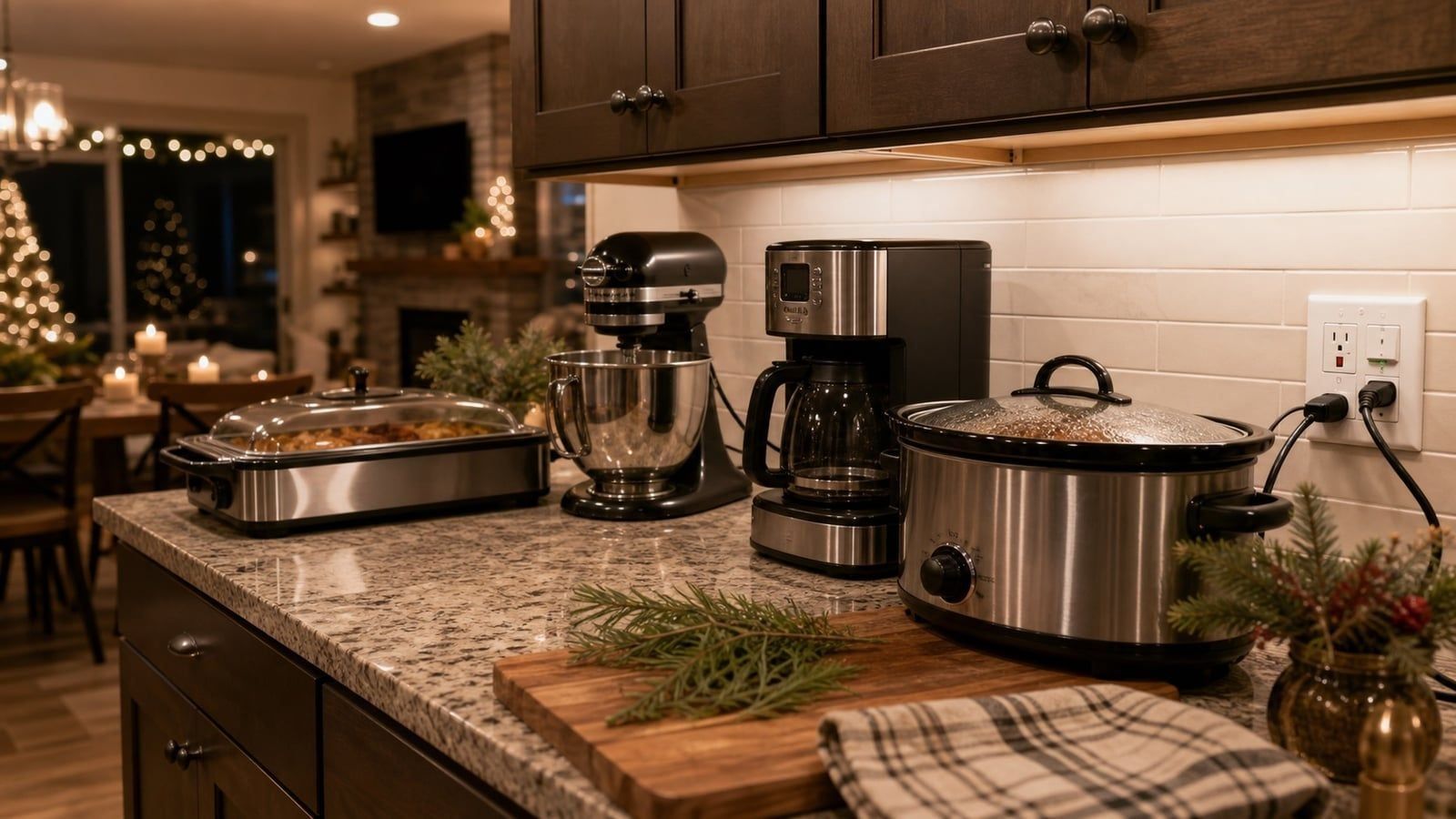
Hosting Holiday Parties? Make Sure Your Home's Electrical System Is Ready
Holiday parties are wonderful—until a circuit breaker trips mid-dinner, plunging your kitchen into darkness. Or worse, someone receives a shock from a faulty outdoor heater. Hosting gatherings means your electrical system faces demands it doesn't see the rest of the year. Here's how to ensure your home is ready to entertain safely and successfully.
The Holiday Hosting Electrical Challenge
Normal daily life uses a fraction of your home's electrical capacity. Holiday parties are different:
Typical weeknight electricity use:
- Lights and TV: 300W
- Refrigerator cycling: 700W average
- Computer and WiFi: 150W
- Furnace blower (cycling): 600W average
- Total average demand: 1,750W
Holiday party electricity demand:
- All house lights on: 800W
- Refrigerator running constantly (door opening): 700W
- Oven: 3,500W
- Cooktop (2-3 burners): 3,000W
- Coffee maker: 1,200W
- Crock pot(s): 300W each
- Warming trays: 200W each
- Dishwasher: 1,800W
- Outdoor heaters: 1,500W each
- Extra fridges/freezers in garage: 700W
- Music/entertainment systems: 500W
- Peak demand: 12,000-15,000W
That's 7-8x your normal usage, and it exposes every weakness in your electrical system.
Kitchen Circuit Capacity: The Critical Bottleneck
Utah kitchens built before 2000 typically have:
- 2 dedicated 20-amp circuits for countertop outlets
- 1 dedicated circuit for dishwasher
- 1 dedicated circuit for garbage disposal
- Large appliances (oven, cooktop) on dedicated circuits
This was adequate for 1990s cooking. Holiday cooking is different.
Real-world holiday kitchen scenario: You're hosting 20 people for Christmas dinner:
Counter circuit #1:
- Coffee maker: 1,200W
- Slow cooker: 300W
- Total: 1,500W on 2,400W circuit (62% capacity)
Counter circuit #2:
- Stand mixer: 500W
- Instant Pot: 1,200W
- Total: 1,700W on 2,400W circuit (70% capacity)
Oven circuit:
- Oven at 350°F: 3,500W on 5,500W circuit (64% capacity)
Cooktop circuit:
- 3 burners active: 3,000-4,000W on 6,000W circuit (60% capacity)
This looks fine, but now add:
- Someone plugs in their phone charger on counter circuit #1
- You turn on the microwave (1,200W) on counter circuit #2
- Counter circuit #2: 2,900W on 2,400W circuit = TRIP
Suddenly you're resetting breakers with a house full of guests.
Identifying Your Kitchen Circuit Capacity
Before your party, you need to know your limits:
Map your kitchen circuits:
- Get a lamp or radio that's easy to hear
- Plug it into each outlet
- Flip breakers one at a time to see which controls which outlet
- Label a kitchen map showing circuit assignments
- Note the amperage on each breaker (15A or 20A)
Calculate safe loads:
- 15-amp circuit: 1,800W max, but only use 1,440W (80% rule)
- 20-amp circuit: 2,400W max, but only use 1,920W (80% rule)
Common kitchen circuit problems:
Problem 1: Multiple outlets on same circuit You might have 6 counter outlets, but they're on just 2 circuits. You need to know which outlets share circuits.
Problem 2: Non-kitchen items on kitchen circuits We often find kitchen circuits also powering:
- Dining room outlets
- Garage outlets
- Outdoor outlets
- Random hallway outlets
During parties, these hidden loads add up fast.
Problem 3: Old 15-amp circuits Homes built before 1980 often have 15-amp kitchen circuits. Modern code requires 20-amp. Those older circuits can't handle modern appliances.
Solution: Circuit load balancing
Once you know your circuit map, create a cooking plan:
Counter circuit #1 (20A):
- Coffee maker (1,200W)
- Slow cooker (300W)
- Remaining capacity: 400W
Counter circuit #2 (20A):
- Instant Pot (1,200W)
- Keep stand mixer unplugged until needed
- Remaining capacity: 700W
Microwave on separate circuit (if available):
- Dedicated 20A circuit: 1,200W
- Remaining capacity: 700W
Critical rule: Never use the microwave while the Instant Pot is running on the same circuit.
GFCI Protection in Wet Areas
Holiday hosting means more water, more spills, and more electrical risks. GFCI (Ground Fault Circuit Interrupter) protection is essential.
Where GFCIs are required by code:
- All kitchen countertop outlets
- All bathroom outlets
- All outdoor outlets
- Garage outlets
- Basement outlets near sinks/water
What GFCIs do:
- Monitor electrical current flow
- Detect current leaking to ground (like through a person)
- Trip in 1/40th of a second
- Prevent electrocution
Holiday GFCI scenarios:
Kitchen spills: Water gets into an outlet from a spilled drink. Without GFCI: shock hazard. With GFCI: outlet trips immediately, no harm.
Bathroom hair dryers: Guest using hair dryer near sink. Water splashes on appliance. GFCI trips before shock occurs.
Outdoor heaters: Snow melts around outdoor heater, creating moisture. GFCI protection prevents shock from damp connections.
Before your party: Test every GFCI
- Press the "TEST" button on each GFCI outlet
- Power should cut off immediately
- Press "RESET" to restore power
- If TEST doesn't cut power, the GFCI is failed—replace immediately
If your home lacks GFCI protection in required areas:
- Each GFCI outlet: $50-75 installed
- Whole-kitchen update (6 outlets): $300-450
- Do this before hosting parties
GFCI troubleshooting during parties:
If a GFCI trips:
- Unplug everything on that circuit
- Press RESET on the GFCI
- If it won't reset, you have a ground fault—call electrician
- If it resets, plug items back one at a time to identify the problem
- If it trips again immediately, that device has a fault—don't use it
Outdoor Heater and Hot Tub Safety
Utah winter parties often include outdoor spaces. Outdoor electrical equipment needs special attention.
Outdoor patio heaters:
Types and power requirements:
- Electric infrared heaters: 1,500W each (12.5A on 120V)
- Propane heaters: No electrical load
- Natural gas heaters: Minimal electrical (ignition only)
Electrical requirements for electric heaters:
- Dedicated outdoor GFCI outlet
- 15A minimum, 20A preferred
- Weatherproof connections
- Elevated connections (not sitting in snow/water)
Critical safety rules:
- Never use indoor extension cords outdoors
- Look for "W" rating on outdoor cords
- Don't daisy-chain multiple heaters on one circuit
- Keep heaters 3 feet from combustibles (furniture, decorations, people)
- Secure cords to prevent tripping hazards
Load calculation for outdoor heating:
You want 3 patio heaters for your deck:
- 3 heaters × 1,500W = 4,500W total
- Requires 2-3 dedicated 20A circuits
- Can't share circuits with indoor loads
If you're running multiple outdoor heaters on extension cords from one outlet, you're overloading the circuit and creating a fire risk.
Hot tub considerations:
Hot tubs require:
- 240V dedicated circuit
- 40-60A breaker (depending on tub size)
- GFCI protection
- Disconnection device within sight of tub
Before a party with hot tub use:
- Test the GFCI
- Verify water chemistry (reduces equipment corrosion)
- Check for any exposed wiring or damage
- Ensure outdoor lighting is adequate
- Confirm cover lifter operates smoothly (prevents strain injuries)
If you're adding a hot tub: This requires professional installation—cost is $800-1,500 for the electrical work alone. Never attempt DIY hot tub electrical.
Temporary Decorative Lighting
Holiday parties mean decorative lighting everywhere—indoors and out.
String lights and fairy lights:
Indoor string lights:
- Typical strand: 20-40W
- 10 strands: 200-400W
- Usually safe on standard circuits (not sharing with kitchen)
Outdoor string lights:
- Must use outdoor-rated lights
- GFCI protection required
- Weatherproof connections
- Keep connections elevated off ground
Common mistakes:
1. Connecting too many strands end-to-end Most light strings allow 3-5 strands maximum. Exceeding this creates fire risk at the connections.
2. Running indoor lights outdoors Indoor lights aren't weatherproofed. Water intrusion = shock and fire hazards.
3. Overloading extension cords If you're running 10 light strands on a single extension cord, check the math:
- 10 strands × 40W = 400W
- Needs 16-gauge cord minimum
- 14-gauge is better for long runs
Candles and electric safety:
Real candles create fire risks, so many people use electric candles. But placement matters:
Window candles:
- Check that cords aren't pinched in windows (damages insulation)
- Don't overload one circuit with 15 window candles
- 15 candles × 7W = 105W (fine, but still check circuit capacity)
Flameless candles: Battery-powered is safest for tables and areas where kids/pets might knock them over.
Entertainment System Loads
Holiday parties mean music, movies, and entertainment systems running for hours.
Typical entertainment system loads:
- TV (65-inch LED): 150W
- Sound system/receiver: 100-300W
- Streaming device: 10W
- Game console: 100-150W (active)
- Total: 360-610W
This is fine on a standard 15A circuit—until you add:
- Christmas tree lights on same circuit: 200W
- Table lamps: 100W
- Phone charging station: 50W
- New total: 710-960W on 1,800W circuit (40-53% capacity)
Still safe, but less margin than you'd think.
Subwoofers and power amps: Higher-end audio systems with separate power amps can draw 500-800W during loud passages. If you're cranking the volume for the party, this might approach circuit limits.
Projector systems: Home theater projectors: 250-400W. This + sound system + sources can approach 1,000W total.
Our recommendation: Entertainment systems should be on dedicated circuits separate from lighting. This prevents lights dimming during loud audio peaks.
Emergency Preparedness for Holiday Parties
Even with perfect planning, things can go wrong. Be prepared:
Keep these accessible:
- Flashlights (with fresh batteries)
- Headlamp for hands-free work
- Circuit breaker panel access clear (not behind stacked storage)
- Electrician's number in phone
Circuit breaker trip procedure:
If a breaker trips during your party:
- Don't panic—this is what breakers are designed to do
- Leave the breaker off for 30 seconds (lets things cool down)
- Unplug or turn off items on that circuit
- Reset the breaker (flip fully OFF, then ON)
- Gradually restore loads to determine cause
If breaker trips immediately upon reset:
- You have a short circuit
- Leave breaker off
- Serve dinner by candlelight (romantic!)
- Call electrician next business day (unless it's critical circuit)
If breaker trips again with loads restored:
- You're overloading the circuit
- Redistribute loads to other circuits
- Run fewer items simultaneously
Critical circuits during parties:
- Kitchen: For cooking and food safety
- Bathrooms: For guests
- Heat: For comfort
- Some lighting: For safety
Non-critical circuits:
- Entertainment systems: Nice but not essential
- Decorative lighting: Can be turned off temporarily
- Outdoor lighting: Can use battery backup
Fire safety readiness:
Before guests arrive:
- Check smoke detector batteries
- Know where fire extinguisher is (and how to use it)
- Clear exit paths of decorations and presents
- Review escape plan with family
- Have 911 entered in phone (obvious, but critical)
Specific fire risks during parties:
- Overloaded circuits in kitchen
- Extension cords under rugs or furniture
- Candles near decorations or curtains
- Cooking unattended (distracted by guests)
- Outdoor heaters too close to combustibles
Generator Backup for Holiday Hosting
If you're hosting major holidays regularly, backup power is worth considering.
Why generators matter for hosting:
- Utah winter storms can cause outages
- Can't postpone Christmas dinner because power is out
- Food safety with 20 lbs of turkey in the oven
- Elderly or young guests need heat
- Your reputation as host
Generator options:
Portable generator + transfer switch ($2,000-3,000):
- Powers critical circuits (kitchen, heat, some lights)
- Manual setup required
- Good for 1-2 day outages
Standby generator ($8,000-12,000):
- Automatic activation within 30 seconds
- Powers whole house
- Party continues seamlessly through outage
- Natural gas powered (no refueling)
Real scenario: We installed a standby generator for a family in Farmington that hosts 40+ people for Christmas every year. Cost: $9,800. They've used it twice during holiday hosting—both times preventing canceled dinners and hotel stays for out-of-town guests. ROI isn't just dollars, it's peace of mind.
Pre-Party Electrical Inspection
If you're hosting major holidays, consider a pre-party electrical inspection:
What we check ($150-200 service call):
- Kitchen circuit capacity and load distribution
- GFCI outlet functionality
- Outdoor outlet conditions and weatherproofing
- Extension cord ratings and conditions
- Panel condition and breaker functionality
- Whole-home safety assessment
Issues we commonly find:
- GFCI outlets that don't trip (failed protection)
- Overloaded circuits not obvious to homeowner
- Loose breaker connections (arcing risk)
- Outdoor outlets not weatherproof
- Aluminum wiring connections needing maintenance (common in 1960s-70s homes)
- Federal Pacific or Zinsco panels (fire hazards requiring replacement)
Timing: Schedule 2-3 weeks before your event. This gives time to address any issues without rushing.
Permanent Solutions for Frequent Hosts
If you host regularly, consider permanent electrical upgrades:
Additional kitchen circuits ($600-1,200): Add 1-2 dedicated 20A circuits for countertop appliances. This eliminates load juggling and breaker trips.
Cost: $300-600 per circuit installed Benefit: Cook without limits, never trip breakers
Dedicated microwave circuit ($400-700): Microwaves draw 1,200W—they deserve their own circuit.
Cost: $400-700 installed Benefit: Use microwave anytime without calculations
Outdoor kitchen/patio circuits ($800-1,500): Multiple 20A GFCI circuits for outdoor:
- Refrigerator/beverage cooler
- Electric grill
- Heaters
- Lighting
- Entertainment
Cost: $200-400 per outlet location Benefit: Full outdoor entertaining capability
Panel upgrade ($3,000-5,000): If your home has 100A service, upgrading to 200A eliminates all capacity concerns forever.
Cost: $3,000-5,000 Benefit: Never worry about electrical capacity again
Whole-home generator ($8,000-15,000): Automatic backup power for hosting regardless of weather.
Cost: $8,000-15,000 installed Benefit: Host with confidence in any weather
Day-of-Party Electrical Checklist
48 hours before:
- Test all GFCI outlets
- Map kitchen circuit assignments
- Test outdoor outlets and heaters
- Charge flashlights and backup batteries
- Clear access to electrical panel
Day of party:
- Turn on only essential lights before cooking starts
- Stagger large appliance use (don't preheat oven while making coffee)
- Set outdoor heaters on timers (30 minutes on, 15 off saves 33% electricity)
- Have backup extension cords and power strips ready (proper ratings)
- Keep electrician's number accessible
During party:
- Monitor outlet temperatures (shouldn't feel warm)
- Listen for buzzing or unusual sounds from outlets
- Watch for dimming lights (indicates overload)
- Keep beverages away from outlets
- Supervise children near electrical items
After party:
- Inspect extension cords for damage
- Check outlets for discoloration (indicates overheating)
- Note any issues for future parties
- Schedule inspection if anything seemed problematic
When to Call an Electrician Immediately
Some situations require immediate professional help:
Emergency situations (call now, even during party):
- Burning smell from outlets, switches, or panel
- Sparking or arcing from any electrical device
- GFCI that won't reset
- Breaker that trips repeatedly immediately upon reset
- Hot outlets or switch plates
- Any shock or tingle felt from appliances or fixtures
Non-emergency but important (call next business day):
- Breakers tripping under normal party loads
- Lights dimming significantly when appliances start
- Outlets not working in critical areas
- GFCI test button doesn't trip the outlet
- Extension cords feeling warm
- Questions about electrical capacity
We're Here to Help You Host Successfully
Holiday entertaining should be about joy, not electrical stress. We help Northern Utah families prepare their homes for hosting:
Our hosting prep services:
- Pre-party electrical inspections
- Kitchen circuit additions
- GFCI upgrades and testing
- Outdoor outlet installation
- Heater circuit installation
- Panel capacity assessments
- Emergency holiday service
Serving all of Northern Utah: Salt Lake City, Ogden, Layton, Kaysville, Farmington, Centerville, Bountiful, and throughout Davis and Weber Counties.
Call 801-458-0831 or request a free quote to prepare your home for holiday hosting.
Brightline Electric is a licensed and insured electrical contractor serving Northern Utah. We're available for emergency service during holidays and provide same-day service for hosting preparation needs.