
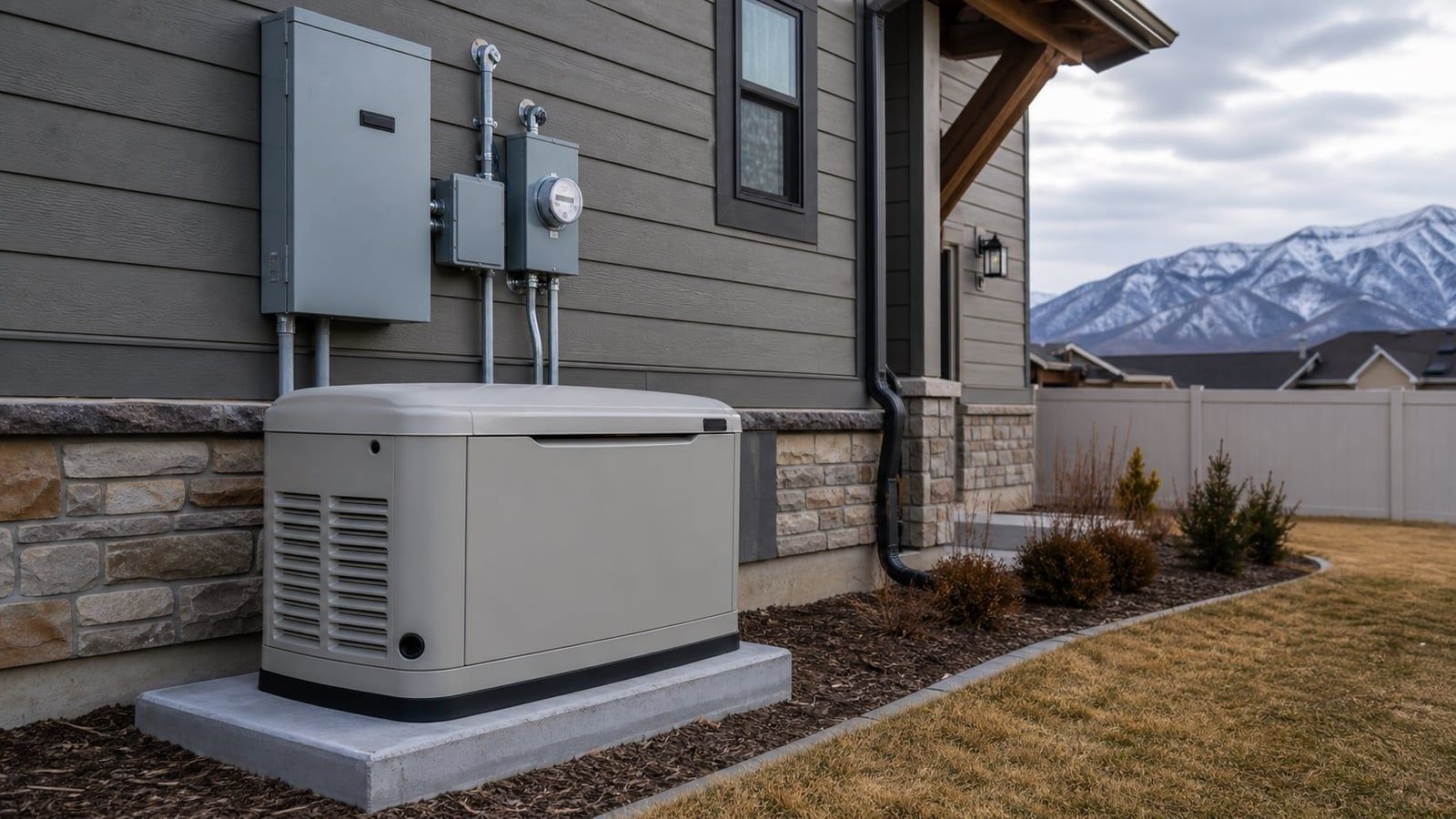
Power Outage Preparedness: Do You Need a Generator for Utah Winter Storms?
Northern Utah winters bring beautiful snow, but also ice storms, high winds, and power outages. In recent years, we've seen major outages lasting hours or even days. When temperatures are below freezing and your heat depends on electricity, a generator isn't a luxury—it's a critical safety device. Here's everything you need to know about generator options for Utah homes.
Understanding Utah's Power Outage Risk
Let's look at the reality of power outages in Northern Utah:
Common causes of winter outages:
- Ice storms weighing down power lines
- High winds (especially in canyons and foothills)
- Snow-loaded trees falling on lines
- Vehicle accidents taking out power poles
- Equipment failures in extreme cold
- Transformer failures from temperature cycling
Recent outage history:
- December 2022: Ice storm left 60,000+ Wasatch Front customers without power
- January 2021: Wind storms caused multi-day outages in Davis County
- February 2020: Heavy snow brought down lines in Weber County
- Winter 2019: Multiple storms caused rolling outages across the region
Duration matters:
- Under 4 hours: Uncomfortable but manageable for most homes
- 4-12 hours: Food safety concerns, heating issues, medical device risks
- 12-24 hours: Critical heating needs, frozen pipe risk, significant disruption
- Over 24 hours: Emergency situation requiring alternative housing or backup power
Who needs a generator most:
- Homes with electric heat (furnace blowers, heat pumps)
- Families with medical equipment requiring power
- Homes with well water systems
- Rural areas where restoration takes longer
- Homes with sump pumps preventing flooding
- Anyone who's been without power 12+ hours in winter
Portable Generators: Pros, Cons, and Costs
Portable generators are the entry-level backup power solution. They're affordable and versatile, but come with significant limitations.
How portable generators work:
- Gas-powered engine generates electricity
- Produces 3,000-10,000 watts typically
- You plug extension cords or a transfer switch connects it
- Manual start (pull-cord or electric start models)
- Requires refueling every 8-12 hours
Real costs (equipment + installation):
- Entry-level 3,500W portable: $400-600 (equipment only)
- Mid-range 5,000-7,000W: $800-1,500 (equipment only)
- Premium 9,000-12,000W: $1,500-3,000 (equipment only)
- Transfer switch installation: $800-1,500 (required for safe connection)
- Total investment: $1,200-4,500
What can you power with portable generators:
3,500W generator (entry-level):
- Furnace blower (600W)
- Refrigerator (700W)
- Several LED lights (60W)
- Phone chargers (25W)
- WiFi router (20W)
- Can't run: Water heater, electric stove, dryer, A/C, multiple major appliances
7,000W generator (mid-range):
- Everything above, plus:
- Microwave (1,000W)
- Coffee maker (1,000W)
- TV and computer (300W)
- More lights and outlets
- Can't run: Whole-house loads, simultaneous heavy appliances
Advantages of portable generators:
- Lower upfront cost
- Can take camping, to job sites, or use elsewhere
- Easier to service and maintain
- No permanent installation
- Can upgrade or replace easily
Disadvantages (these are significant):
- Must be outside: Carbon monoxide kills—generators must be 20+ feet from house
- Manual operation: You must physically set up, start, refuel, and monitor
- Weather exposure: Operating a generator in a blizzard at 2 AM is miserable
- Fuel storage: You need gasoline on hand (stabilizer required, 6-month shelf life)
- Noise: 65-75 decibels—neighbors will know you have it
- Limited runtime: Refueling every 8-12 hours
- No automatic start: Power goes out at 3 AM, you wake up cold
- Extension cord risks: If not using transfer switch, extension cords create hazards
The transfer switch requirement:
Never backfeed power into your panel by plugging a generator into an outlet. This is illegal, dangerous, and can kill utility workers. You need a transfer switch:
Manual transfer switch ($800-1,500 installed):
- Electrician installs a subpanel with switch
- During outage, you switch selected circuits to generator power
- Physically disconnects house from grid (safe)
- You choose which circuits get generator power (usually 6-10 circuits)
The circuit selection reality: You can't power everything. You choose critical circuits:
- Furnace
- Refrigerator/freezer
- Some lights and outlets
- Well pump (if applicable)
- Sump pump (if applicable)
- Medical equipment
Fuel storage considerations:
Gasoline storage is actually a big deal:
- Store in approved containers (5-gallon gas cans)
- Add fuel stabilizer (gasoline degrades in 3-6 months)
- Keep minimum of 20 gallons on hand for multi-day outages
- 7,000W generator uses ~0.75 gallons/hour at 50% load
- Store away from house, water heaters, and ignition sources
- Utah fire code limits residential gasoline storage to 25 gallons
True cost of portable generator ownership:
- Generator: $1,500 (mid-range)
- Transfer switch installation: $1,200
- Gas cans and stabilizer: $100
- Annual fuel stabilizer replacement: $30
- Maintenance (oil, filters, spark plugs): $100/year
- First year: $2,900
- Annual ongoing: $130
Standby Generators: The Premium Solution
Standby generators are permanently installed, automatically starting when power fails. They're expensive, but provide true peace of mind.
How standby generators work:
- Permanently installed next to your home
- Runs on natural gas or propane (no refueling)
- Automatic transfer switch detects outage and starts generator (within 30 seconds)
- Can power whole house or selected circuits
- Runs indefinitely as long as gas supply continues
- Weekly self-test to ensure readiness
Real costs (installed):
- 10-14kW system (partial house): $5,000-8,000
- 16-20kW system (most of house): $7,000-11,000
- 22-26kW system (whole house): $9,000-15,000
- Natural gas line extension (if needed): $1,500-3,000
- Propane tank and line (if no natural gas): $2,000-4,000
- Electrical permit and inspection: $200-500
- Total investment: $7,000-20,000
What determines the cost:
- Generator size (kW capacity)
- Distance from gas line
- Electrical panel complexity
- Concrete pad requirements
- Local permit fees
- Site preparation needs
Advantages of standby generators:
- Automatic operation: Power fails, generator starts—no action needed
- Whole-house capability: Size appropriate to run everything
- No refueling: Connected to natural gas or large propane tank
- Quiet operation: 55-65 decibels (quieter than portable)
- Weather-protected: Enclosed housing handles Utah winters
- Unlimited runtime: Runs as long as outage lasts
- Increases home value: Permanent improvement
Disadvantages:
- High upfront cost: $7,000-20,000 is substantial
- Professional installation only: Not a DIY project
- Permitting required: Setback requirements, inspections
- Annual maintenance: $200-300 for service (oil change, inspection)
- Natural gas dependency: If gas service fails, generator won't run (rare)
Sizing a standby generator correctly:
This requires a professional load calculation, but here's the general guidance:
10-14kW (smaller homes):
- Powers essential circuits: furnace, fridge, lights, outlets
- Won't run central A/C, electric water heater, or dryer simultaneously
- Good for 1,500-2,500 sq ft homes with gas appliances
- Cost: $5,000-8,000 installed
16-20kW (most Utah homes):
- Powers most of house: all essentials plus comforts
- Can run central A/C OR electric dryer, not simultaneously
- Good for 2,000-4,000 sq ft homes
- Most popular size for Utah families
- Cost: $7,000-11,000 installed
22-26kW (whole house):
- Powers everything including A/C, dryer, electric range
- No load management needed
- Good for 3,500+ sq ft homes or homes with many electric appliances
- Cost: $9,000-15,000 installed
Load management systems:
Modern standby systems include smart load management:
- System monitors which appliances are running
- Prevents overload by temporarily shedding non-critical loads
- Means you can install a smaller generator (saves $2,000-4,000)
- Example: If dryer starts while A/C is running, system temporarily turns off A/C
Natural Gas vs. Propane: Fuel Considerations
Your fuel choice affects cost, runtime, and convenience.
Natural gas (preferred in urban areas):
Advantages:
- Unlimited fuel supply during outages
- No refueling ever
- Lower operating cost ($1.50-2.00/hour)
- Already connected to most Utah homes
- Clean-burning
Disadvantages:
- Not available in rural areas
- If gas service fails (rare), generator won't run
- May need larger gas line installed ($1,500-3,000)
- Lower energy density (slightly larger generator needed)
Propane (preferred in rural areas):
Advantages:
- Available anywhere
- Independent of utility (if your gas service is out, propane still works)
- Higher energy density (more efficient)
- Can share tank with home heating
Disadvantages:
- Limited fuel supply (typical 500-gallon tank)
- Propane tank rental or purchase ($1,500-3,000)
- Refilling logistics during extended outages
- Higher operating cost ($2.50-3.50/hour)
- Cold weather reduces propane pressure (can affect large loads)
Runtime on propane:
500-gallon tank (400 usable gallons) at 50% generator load:
- 10kW generator: ~120 hours (5 days)
- 16kW generator: ~80 hours (3.3 days)
- 22kW generator: ~60 hours (2.5 days)
Most propane-powered standby installations use 500-1,000 gallon tanks.
Installation Requirements and Timelines
Generator installation isn't quick or simple. Here's what's involved:
Site requirements:
- Minimum setbacks from house, property lines, windows (varies by jurisdiction)
- Typical: 5 feet from house, 5 feet from property line
- Level concrete pad or gravel base
- Clearance for exhaust and ventilation
- Access for maintenance and fuel delivery (propane)
Electrical work:
- Automatic transfer switch installation (4-8 hours)
- Load center modifications
- Generator connection and testing
- Permit and inspection
Gas work:
- Natural gas line extension from meter
- Gas pressure testing and inspection
- Propane tank installation and connection
- Gas permit and inspection
Typical timeline:
- Consultation and sizing: 1 week
- Permit approval: 2-4 weeks
- Equipment ordering: 2-6 weeks (depending on model)
- Installation: 1-2 days
- Inspection and startup: 1 week
- Total: 6-12 weeks from decision to operation
The seasonal reality:
Generator demand spikes after major outages. After the December 2022 ice storm, we had a 3-month backlog for generator installations.
Best time to install: Late summer/early fall
- Beat the winter rush
- Better weather for installation
- Parts readily available
- Ready before winter storms hit
Worst time: After a major outage
- Everyone wants one simultaneously
- Extended wait times
- Parts shortages
- Premium pricing
Critical Circuits: What Should Your Generator Power?
Whether portable or standby, you need to prioritize what gets backup power.
Tier 1 - Critical (life safety):
- Furnace/heating system: Prevents freezing, maintains life safety
- Medical equipment: CPAP, oxygen concentrators, etc.
- Well pump: If you have well water
- Sump pump: Prevents basement flooding
Tier 2 - Important (food and comfort):
- Refrigerator and freezer: Prevents food loss
- Kitchen outlets: For cooking (microwave, coffee maker)
- Lighting: At least one light in each major area
- Phone chargers and WiFi: Communication and information
Tier 3 - Comfort (nice to have):
- TV and entertainment: Morale during extended outages
- Computer/office: For work-from-home
- Garage door opener: Vehicle access
- Additional outlets: General convenience
Tier 4 - Optional (use carefully):
- Electric water heater: Huge load (4,500W), not critical short-term
- Central A/C: Huge load, usually not needed in winter
- Electric dryer: Huge load (5,000W), not essential
- Electric range: Huge load, use microwave instead
Generator sizing math:
Add up the running wattage of everything you want to power simultaneously. Then add 20% for surge capacity (motors and compressors draw 2-3x their running wattage when starting).
Example for 7,000W portable generator:
- Furnace: 600W running (1,800W starting)
- Refrigerator: 700W running (2,100W starting)
- Freezer: 500W running (1,500W starting)
- Lights (10 LEDs): 100W
- TV and WiFi: 150W
- Phone chargers: 50W
- Total running: 2,100W
- Largest starting surge: 2,100W (fridge or freezer)
- Peak demand: 4,200W
- Available capacity: 7,000W
- Margin: 2,800W (40% buffer)
This is properly sized. You can't run everything, but you have the essentials covered.
Maintenance and Operating Costs
Generators require maintenance. Neglect them, and they fail when you need them most.
Portable generator annual maintenance:
- Oil change (every 50-100 hours or annually): $30
- Air filter replacement: $15
- Spark plug replacement: $10
- Fuel stabilizer (if stored with fuel): $20
- Load testing: DIY
- Annual cost: ~$75
- Plus your time: 2-3 hours
Standby generator annual maintenance:
- Professional service (oil, filters, battery, inspection): $200-300
- Weekly self-tests (automatic): $0
- Battery replacement (every 3-5 years): $100
- Annual cost: $250-350
Critical: Generators that sit unused for years often fail during outages. Run portable generators under load quarterly. Standby generators self-test weekly automatically.
Alternatives and Combinations
Generators aren't the only backup power option.
Battery backup systems (like Tesla Powerwall):
Advantages:
- Instant switchover (no 30-second delay)
- Silent operation
- No emissions
- Can work with solar
- Daily use for peak shaving
Disadvantages:
- Expensive ($12,000-20,000 installed)
- Limited capacity (13.5 kWh = 12-24 hours depending on usage)
- Won't run high-load appliances long
- Can't recharge during extended outages (unless paired with solar)
Best for: Daily energy management with backup capability, not extended outages
Hybrid approach (portable + key circuits):
Some homeowners install a transfer switch for critical circuits, then add a portable generator as needed:
- Transfer switch: $1,200 installed
- Critical circuits (furnace, fridge, lights): Switched
- Portable generator: $1,500
- Total: $2,700
You get automatic disconnection safety with flexibility to upgrade to standby later.
Inverter generators (premium portables):
Quieter, cleaner power, more efficient:
- 3,000W inverter: $1,000-1,500
- 7,000W inverter: $2,500-4,000
- Better power quality (safe for electronics)
- 50% quieter operation
- 30% better fuel efficiency
Real Utah Homeowner Scenarios
Let's look at actual situations we've helped with:
Scenario 1: Young family in Layton (1,800 sq ft)
- Gas furnace, electric blower
- Fridge and freezer
- Budget: $3,000
- Solution: 7,000W portable + manual transfer switch
- Powers furnace, kitchen, lights
- Cost: $2,800 installed
- Satisfied: Can handle 2-3 day outages comfortably
Scenario 2: Retired couple in Ogden (2,400 sq ft)
- CPAP machines (both)
- Electric heat pump system
- Budget: $10,000
- Solution: 16kW natural gas standby
- Whole-house power
- Cost: $9,200 installed
- Satisfied: Total peace of mind, automatic operation
Scenario 3: Rural property in Weber County (3,200 sq ft)
- Well water system
- Propane heating
- Frequent outages (2-3 per winter)
- Solution: 20kW propane standby with 500-gallon tank
- Whole-house power, independent fuel source
- Cost: $13,800 installed
- Satisfied: No more hauling water, always has heat
Scenario 4: Growing family in Farmington (2,000 sq ft)
- Limited budget now
- Want to expand later
- Solution: Transfer switch + inlet for future generator
- Can use borrowed/rented generator now
- Upgrade to standby when budget allows
- Cost: $1,500 installed
- Satisfied: Flexibility and safety now, expansion path later
Making the Decision: Do You Need a Generator?
Ask yourself these questions:
Have you lost power for 6+ hours in the last 3 years?
- Yes = Generator worth considering
- Multiple times = Generator strongly recommended
Do you have electric heat or heat pump?
- Yes = Generator moves from "nice" to "necessary"
Does anyone have medical equipment requiring power?
- Yes = Generator is critical, not optional
Do you have well water?
- Yes = Generator needed (no power = no water)
What's your cold-weather backup plan?
- None = Generator needed
- Stay with family/hotel = Maybe skip generator
- Fireplace + camping stove = Portable generator probably sufficient
What's your budget?
- Under $3,000 = Portable + transfer switch
- $5,000-8,000 = Smaller standby system
- $8,000-15,000 = Properly sized standby system
- Over $15,000 = Premium whole-house system
How important is convenience?
- Very important = Standby system
- Can handle manual operation = Portable acceptable
We're Here to Help
Generator selection and installation requires professional electrical knowledge. We help Northern Utah families choose the right backup power solution for their needs and budget.
Our generator services:
- Free consultation and load calculations
- Portable generator transfer switch installation
- Standby generator installation (all major brands)
- Permits and inspections
- Annual maintenance and service
- Emergency repairs when generators fail
Brands we install and service:
- Generac (most popular)
- Kohler
- Briggs & Stratton
- Cummins
- Champion
Financing available: Many homeowners finance generator installations over 3-5 years, making monthly costs manageable.
Serving all of Northern Utah: Salt Lake City, Ogden, Layton, Kaysville, Farmington, Centerville, Bountiful, and throughout Davis and Weber Counties.
Call 801-458-0831 or request a free quote for generator consultation.
Brightline Electric is a licensed and insured electrical contractor serving Northern Utah. We're authorized dealers and installers for major generator brands, with emergency service available 24/7.